How Water Damage Restoration Works: From Extraction to Recovery
Water damage is deceptively fast in its destructive potential. What may begin as a slow leak or minor overflow can, within hours, compromise drywall, flooring, structural wood, and personal property. If left unchecked, moisture fosters mold growth, rotting, odors, and long-term structural failure. That’s why an effective water damage restoration is not just about cleanup—but about a methodical, scientific process from extraction to full recovery.
In this article, we’ll walk through how water damage restoration works, step by step: from initial arrival and extraction through drying, monitoring, repair, and final reporting. We’ll also highlight the types of water situations (clean water, gray water, black water) and why each requires a different approach, as well as the crucial role of certification and insurance coordination.
Why Speed and Method Matter
When water floods a property—even in small amounts—the clock is ticking:
Within minutes to hours, water seeps into carpets, flooring, drywall, baseboards, and wall cavities.
Within 24–48 hours, mold spores may begin to germinate and spread.
Structural materials (wood, drywall, insulation) can warp, swell, delaminate, or deteriorate.
Odors, stains, and microbial growth escalate.
Thus, a fast, organized response is essential to minimize damage, cost, and health risks. The best restoration firms are ready 24/7, equipped with specialist tools, and operate following industry standards. MSI, for instance, presents itself as an IICRC-certified firm (Institute of Inspection, Cleaning and Restoration Certification), meaning it adheres to validated protocols for water extraction, drying, disinfection, and restoration.
The Restoration Process: Step by Step
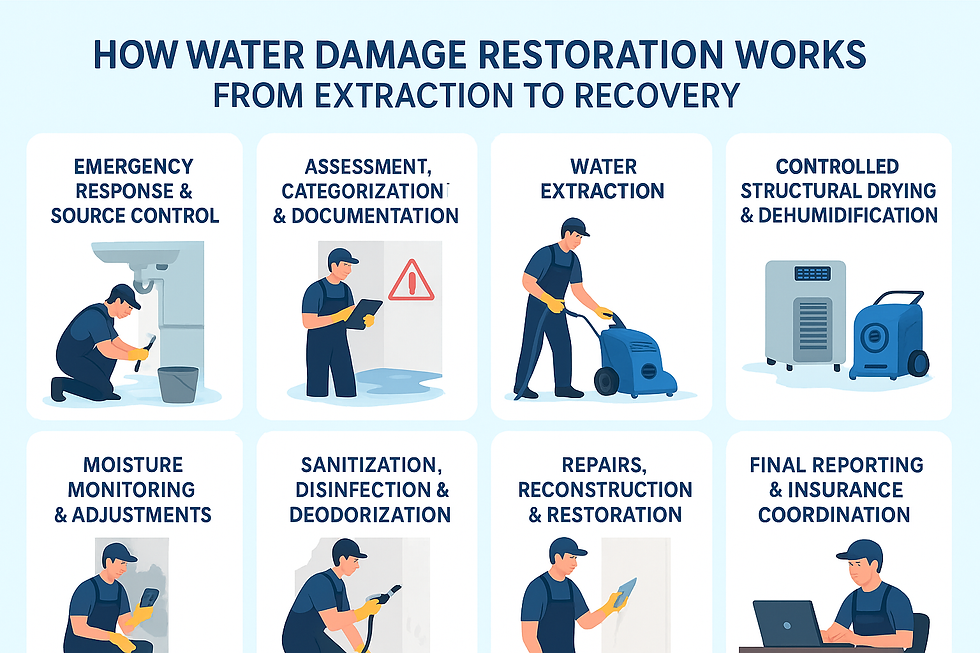
Here is a detailed breakdown of how restoration typically proceeds:
1. Emergency Response & Source Control
Objective: Stop further intrusion, prevent escalation, and secure the site.
The restoration team is dispatched immediately (MSI emphasizes they respond 24/7)
On arrival, the technicians locate and stop the source of water (e.g., pipe rupture, leaking appliance, roof leak). This step is vital—without ceasing the ingress, any further work is futile.
They set up containment if needed (e.g., plastic sheeting, barriers) to isolate affected zones and prevent cross‐contamination.
2. Assessment, Categorization & Documentation
Objective: Understand the damage, classify water type, plan restoration, and document for insurance.
Inspect all impacted areas, taking photos and recording moisture readings.
Categorize the water intrusion, using standard industry definitions:
Category 1 (Clean Water): From a sanitary source (e.g., broken water line, sink overflow) with minimal contamination risk.
Category 2 (Gray Water): Contains significant contamination (e.g., dishwasher overflow, washing machine leak, toilet overflow without solids). Requires treatment or disinfection.
Category 3 (Black Water): Highly contaminated (e.g., sewage, floodwaters, stagnant water). This is hazardous and demands full protective measures.
Identify which building materials and contents (e.g., carpet, drywall, insulation, baseboards, furniture) are affected and whether they should be removed, sanitized, or dried in place.
Generate a restoration plan and scope of work.
Compile documentation (photographs, moisture logs, notes) essential for insurance claims. MSI states that they provide final reports, logs, invoices to clients and insurers.
3. Water Extraction
Objective: Remove standing water as rapidly as possible.
Use high-capacity pumps and industrial wet vacuums to remove bulk water from floors, wall cavities, and low-lying areas.
For carpets or rugs, specialized extraction tools (e.g., weighted extractors, carpet wands) help lift water out of fibers.
Sometimes removal or drilling of small holes in wall voids or baseboards is done to allow water trapped behind surfaces to be extracted.
The faster extraction occurs, the less residual moisture remains.
4. Controlled Structural Drying & Dehumidification
Objective: Dry all affected materials thoroughly and evenly, preventing secondary damage and mold growth.
After extraction, rapid drying is initiated using air movers (high-velocity fans) and commercial dehumidifiers.
Air movers are arranged to create airflow across surfaces—floor, walls, ceilings—accelerating evaporation.
Dehumidifiers reduce ambient humidity so moisture evaporated from materials is removed from the air, not just reabsorbed.
For particularly sensitive or damaged zones, containment (e.g., plastic barriers) might be erected to concentrate airflow and dehumidification.
Technicians continuously measure moisture levels in materials (wood, drywall) and air (humidity, wet bulb/dry bulb) to monitor progress.
If drying stalls or unexpected pockets of moisture remain, adjustments are made: reposition fans, add more dehumidifiers, or open access.
5. Moisture Monitoring & Adjustments
Objective: Ensure that drying is proceeding as planned and take corrective action if not.
Daily readings are taken—before, during, and after drying—to track moisture trends.
Compare readings to baseline dry standards for different materials.
If moisture levels are not declining sufficiently, alternative strategies are applied: increasing airflow, adding more equipment, or removing obstructing materials.
This adaptive monitoring continues until all affected building materials reach acceptable dryness.
6. Sanitization, Disinfection & Deodorization
Objective: Eliminate microbial threats, odors, and contaminants.
Especially for gray or black water scenarios, sanitizing agents, biocides, or antimicrobial treatments are applied to surfaces to inhibit mold, bacteria, and pathogens.
Nonporous surfaces (concrete, tile, metal) are easier to disinfect; porous materials might need removal or deeper treatment.
Odor control may involve ozone or hydroxyl treatments, activated charcoal, or specialized masking agents.
All treatments are applied carefully, following health and safety protocols.
7. Repairs, Reconstruction & Restoration
Objective: Return the space to its pre-loss condition (or better).
Replace irreparably damaged materials—drywall, insulation, baseboards, floor coverings—as per the restoration plan.
Repair structural components (framing, subflooring) if warped or compromised.
Reinstall finishes, repaint, reinstall trim, baseboards, moldings, or fixtures.
Reintegrate salvaged contents (furniture, electronics) once safe.
Conduct a final walkthrough to ensure that everything is functioning, clean, and aesthetically restored.
8. Final Reporting & Insurance Coordination
Objective: Close the project, provide accountability, and assist with claim settlement.
Prepare and deliver a final report, including documentation: before/after photos, drying logs, moisture readings, invoices, and a summary of work completed.
Some firms (like MSI) offer to liaise with your insurance company, manage claims, and streamline billing.
Provide guidelines or preventive advice to the property owner (e.g., leak detection systems, moisture monitoring, maintenance tips).

Special Considerations & Challenges
Category of Water Determines Strategy
As noted, clean, gray, and black water differ in contamination risk and required safety protocols. A Category 3 scenario demands full protective equipment, containment, and likely the removal of porous materials. Misclassifying water type can risk health and improper restoration.
Hidden Moisture & “Secondary Damage”
Often the most damaging moisture hides behind walls, under flooring, or above ceilings. If left unchecked, it can cause structural decay, mold growth, or hidden deterioration. That’s why careful moisture scanning and access opening (drilling, cutting) are sometimes required.
The Role of Structural Materials
Different materials dry at different rates. Wood, drywall, and masonry each behave differently. For instance:
Wood may swell or crack if dried too fast or unevenly.
Drywall loses integrity when saturated; sometimes removal is the safer choice.
Insulation (e.g., fiberglass) may trap water and bacteria; sometimes it must be removed.
A good restoration firm understands these nuances and tailors the drying process carefully.
Monitoring & Equipment Calibration
Restoration is not “set it and forget it.” Continuous monitoring ensures the process stays on track. Equipment must be well-calibrated, and adjustments made as conditions evolve.
Health & Safety Risks
Water damage—especially with contaminated water—carries health risks (mold, bacteria, pathogens). Restoration crews must follow safety protocols, wear PPE (gloves, respirators, boot covers), and isolate zones as needed.
Insurance & Documentation
Insurance claims around water damage can be complex. Without rigorous documentation and accurate scoping, the claim may be partially denied or underpaid. Restoration firms with experience in insurance advocacy provide valuable support.
Typical Timeline
While every situation differs, a residential water damage restoration might follow this rough timeline:
Phase | Duration | Comments |
Emergency response & extraction | Within hours | The faster, the better |
Assessment & planning | 1–2 hours (overlaps with extraction) | To guide drying strategy |
Structural drying & dehumidification | 2–5 days | Depends on severity and materials |
Repair & reconstruction | Several days to weeks | Variable, depending on scope |
Final reporting & closure | Concurrent with final work | For insurance and client transparency |
As MSI notes, “most residential drying jobs take between 3–5 days,” depending on water volume and affected materials.
Why Certification & Professional Standards Matter
Not all restoration companies are equal. Hiring a certified firm (e.g., IICRC-certified) ensures:
They adhere to established protocols and standards.
Technicians have formal training.
Methods and materials used are industry-accepted and safe.
Proper documentation is maintained.
MSI highlights being an IICRC-certified firm, which gives clients greater confidence in the process and results.
Additionally, because MSI is an approved vendor for major insurance carriers, they can coordinate claims and reduce client stress.
Real Risks If You Don’t Restore Properly
Mold & Mildew Growth: Within 24–48 hours, spores can germinate and spread.
Structural Degradation: Wood warps, drywall crumbles, flooring buckles.
Health Hazards: Bacteria, allergens, and pathogens can proliferate.
Reduced Property Value & Insurance Issues: Long-term damage may deter buyers or lead to costly repairs.
Thus, professional restoration is not simply a cosmetic fix—it’s protecting health, safety, and investment.
Tips for Property Owners
Act immediately: The faster you call professionals, the more you can limit damage.
Turn off electricity if floating water touches outlets or wiring.
Remove valuables (fabrics, electronics) from affected zones if safe to do so.
Document damage: Take photographs and notes for your records and for insurers.
Avoid DIY overconfidence: Trying to dry an entire flood-impacted zone without industrial equipment or testing is risky—hidden moisture or lack of proper drying often leads to more trouble.
Work with restoration and insurance professionals hand in hand.
Use preventive measures: Leak detection systems, regular plumbing inspections, moisture barriers, and maintenance can reduce future risk.
A Simplified Flowchart
Water intrusion → Emergency call → Arrival
Stop source → Secure/contain
Inspect, categorize, document
Extract standing water
Deploy air movers & dehumidifiers
Monitor moisture → Adjust equipment as needed
Sanitize, deodorize
Repair, replace, reconstruct
Final documentation, client walk-through, insurance coordination
Water damage restoration is a scientific, methodical, and time-sensitive process. A well-trained, certified restoration firm follows structured stages—from emergency response and source control to detailed drying, monitoring, sanitization, and reconstruction. Each step matters: skip or skimp on any stage, and you risk hidden moisture, mold, structural failure, or health hazards.
The critical takeaways:
Speed is essential. Time lost means more damage.
Assessment and categorization are foundational. Different types of water demand different treatments.
Extraction must be thorough, followed by controlled drying and continuous monitoring.
Sanitization and reconstruction restore safety and aesthetics.
Documentation and insurance liaison finalize the process and protect your interests.
Choose certified, professional firms. That helps ensure quality, safety, and accountability.


Comments